
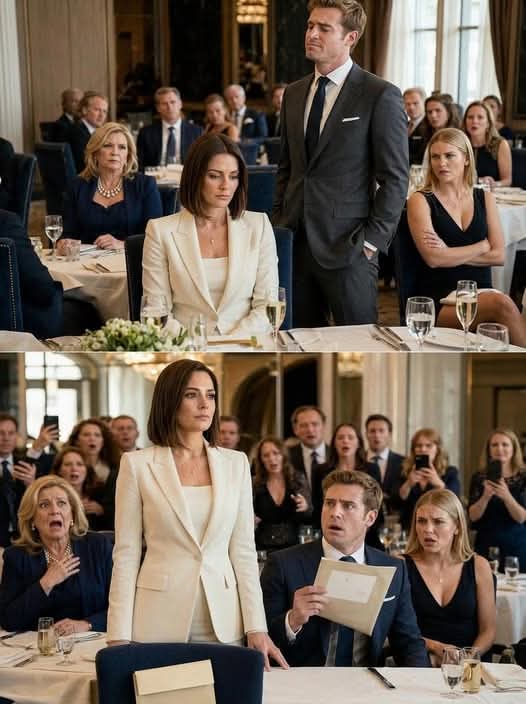
The night my fiancé told me to stop calling him my “future husband,” something inside me went quiet. Around us the dinner continued—my future mother-in-law’s loud laughter scattering through the dining room like broken glass—but whatever trust I had felt simply stopped.
It began with a small remark as I slid olives off his plate. Adrien’s reaction surprised me. He set his glass down and, with that composed, slightly aloof charm he cultivated, told me not to call him my future husband. “Not yet,” he said quietly, and the softness of his voice made the words colder.
His sister Camille smirked as if I’d asked for trouble by using the word, while his mother Vivienne kept staring at my engagement ring as though she regretted having let me wear it. In front of everyone, Adrien reiterated that we were only engaged—not married—so “husband” was premature. He added that calling him that made things seem too permanent, too fast.

Vivienne chimed in about men needing space. Camille joked that it must be hard when someone “marries up,” her smile edged with malice.




My throat burned, but years of corporate meetings had taught me how to stay composed when underestimated. I sat with my hands folded and said nothing.
Adrien touched my wrist in the patronizing way adults soothe a child and told me he loved me.
That claim followed me after we left the table. He “loved” me for helping secure a bridge loan while his company was near collapse—thanks to my father’s venture capital firm. He “loved” me for the introductions I provided and the access I opened. His love seemed tied to how useful I was to him.
That night he slept in my penthouse while I sat in my office, going through every wedding-related file: guest lists, vendor agreements, hotel bookings, security arrangements, private events for his family and investors. I removed my name from every single one.
Before dawn I started making calls. By morning, the wedding he had envisioned no longer existed.
Two days later he assumed I was merely upset. He sent flowers with a note telling me to “be reasonable,” then texts begging me not to humiliate him. His mother apparently believed I owed Camille an apology; we were to have lunch on Friday for appearances’ sake.
The lunch was set for Bellamy House, a private club with plush décor, old portraits, and a guest list that didn’t gossip but never forgot anyone’s sins. Adrien had invited relatives, investors, friends, and a society editor who would likely cover our wedding.
What he didn’t know was my family’s connection to Bellamy House—my grandmother had helped found it, and her portrait hung in the garden room. People there may not have recognized Adrien, but they knew me.
That Friday I wore a careful ivory silk dress. My assistant Noelle brought a folder of confirmations: deposits for the wedding were tied to my accounts, contracts bore my authorization. If I withdrew consent, Adrien would lose everything.

That wasn’t all. An inquiry into his finances revealed defaulted loans and inflated contracts—one client never signed, another had withdrawn months earlier, and one contract falsely used my father’s firm as leverage. His business was teetering.
Suddenly his motives were clear. He wasn’t marrying me out of love—he was securing safety for his collapsing empire.
At Bellamy House the staff worked quietly as plans shifted. Seating cards disappeared, reservations were altered, menus changed. On Adrien’s chair I placed a cream envelope sealed with black wax.
Inside: an official termination of our engagement, paperwork canceling any wedding arrangements tied to my name, the foreclosure notice for his business loan, and a photo.
The photo showed Adrien kissing Tessa—Camille’s best friend—by a hotel lift. I’d received that picture anonymously weeks earlier but had ignored it; love can blur some things.

Guests arrived and the room buzzed. Vivienne swept in, pearls and cold entitlement, demanding to know why I sat at the head table. Staff answered firmly: not today.
Camille laughed at first, thinking it a mistake. The mood shifted when Adrien entered and saw me beneath my grandmother’s portrait—and then saw the envelope on his chair.
His composure drained. He approached slowly, inspecting the papers as if they might explode; men like him despised paper because it proved things.
He tried to claim I was making a scene. I told him scenes were pointless if the audience wasn’t worth entertaining. Camille grabbed the envelope and read; her face lost color. Adrien snatched the documents and saw: the engagement was over.
At the photo, the table fell silent. Tessa looked frightened, Vivienne demanded answers, an investor recoiled. Adrien tried to downplay it—many couples survived infidelity, he said. I pointed out businesses don’t.

Panic replaced his arrogance. I calmly explained his loan was in default, his board had been notified, and auditors were investigating his fabricated contracts. He had never looked so frightened.
Vivienne attempted a countermove, and I hinted at questionable jewelry purchases tied to company funds. Then the phones on the table began to ring.
News of our breakup was already circulating—not yet the compromising photo, but enough to let people wonder what else I might reveal. Adrien begged for privacy; he had no problem humiliating me publicly over a casual dinner remark, so I didn’t indulge him now.
I reminded him that I had only followed his instruction: he told me not to call him my future husband, and I obeyed. I removed the engagement ring and placed it gently on his untouched plate.
Consequences followed quickly. His board asked him to step down within hours, auditors opened investigations, Vivienne began selling jewelry to cover debts, and Camille’s event business collapsed after her insulting messages about clients leaked online.

Six months later I purchased the garden room at Bellamy House and renamed it for my grandmother. At the opening, candles flickered and soft music played. I wore black silk instead of a wedding gown and felt like myself—free of others’ expectations.
No one mentioned Adrien that night. I knew he was out there trying to repair his reputation with people who no longer trusted him. When someone called my name across the room, I turned and felt whole—not because someone had chosen me, but because I had chosen myself.